
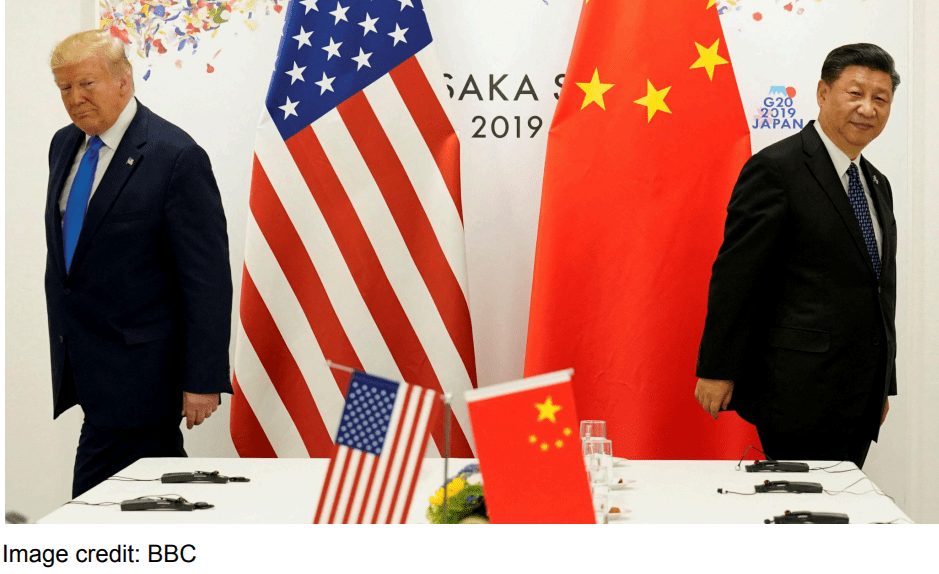
The U.S.-China trade war, which began in 2018, escalated in early 2025, especially with
the inauguration of President Donald Trump who won second term years after he
served his first term. Trump slammed tariffs on China, Canada, Mexico and other
countries after he returned to power in the US.
In January, China imposed export controls on 28 U.S. companies, including defence
contractors Lockheed Martin and Boeing Defense. China cited national security
concerns as its reason for taking such action. This move signals Beijing’s increasing
readiness to retaliate against U.S. actions.
The U.S. has responded by maintaining and, in some cases, increasing tariffs on
Chinese imports. These measures have led to higher costs for American consumers
and businesses, particularly in sectors reliant on Chinese manufacturing. Products such
as electronics, apparel, and raw materials have seen price hikes, affecting both end
consumers and manufacturers dependent on these imports.
Notably, global supply chains have been significantly disrupted by these trade tensions
between the two leading countries. Companies are diversifying their manufacturing
bases to reduce the risks associated with the bilateral tensions between the US and
China. Nations like Vietnam, India, and Mexico have emerged as alternative
manufacturing hubs as they benefit from the shift away from China. This reconfiguration
aims to reduce dependence on any single country and to navigate the complexities of
the current trade environment.
Despite these adjustments, the global economy faces challenges in the coming months
and years. The International Monetary Fund (IMF) has noted a slowdown in global
economic growth, attributing it partly to ongoing trade face-offs. Businesses worldwide
are grappling with increased uncertainty, leading to cautious investment and hiring
decisions.
As 2025 progresses, the direction of U.S.-China trade relations remains uncertain. Both
nations appear firm in their respective positions, with economic and strategic
considerations influencing policy decisions. Meanwhile, the global community watches
closely, knowing that prolonged tensions could have lasting impacts on international
trade and economic stability.