
The economic outlook of any country is important to the government, investors, and other stakeholders who are interested in that country. As a continent that is very attractive for business, the economic outlook of African countries is of great importance not only to African governments and Africans themselves but also to foreign investors who are interested in doing business in those nations.
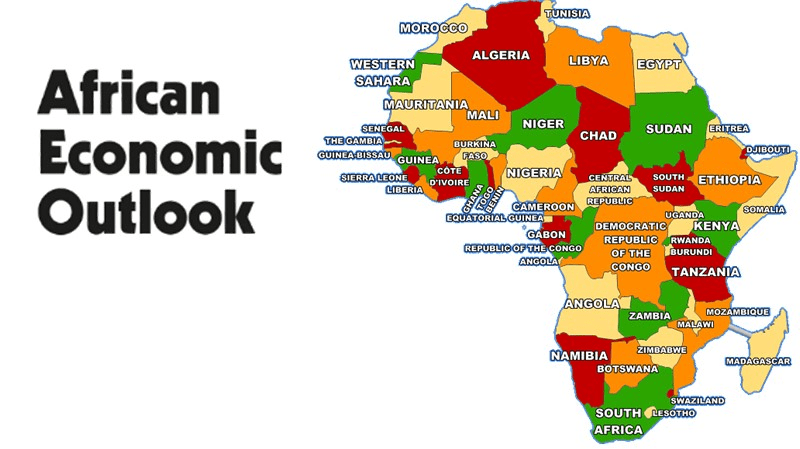
There is a mixed outlook for African nations for the years 2025 and 2026, which are two years that will receive significant attention for now. According to recent data from the African Development Bank (AfDB), while some countries have a good Gross Domestic Product (GDP) with a projection of further growth in 2026, others are expected to experience a decline next year.
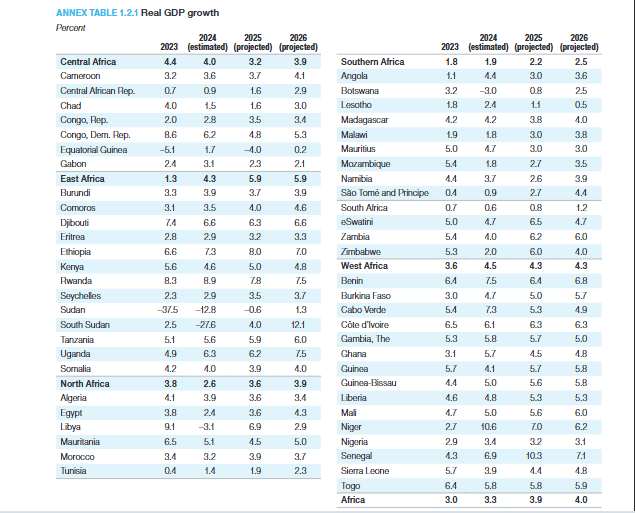
Some countries with a positive real GDP for the year 2025 with the projection of a further growth in 2026 include Djibouti from 6.3% to 6.6%, Uganda from 6.2% to 7.5%, Mali from 5.6% to 6.0%, Burkina Faso from 5.0% to 5.7%, and notably South Sudan from 4.0% to 12.1% among others. Also, some countries are expected to maintain their current GDP growth rates in 2026, such as Mauritius at 3.0%, Côte d’Ivoire at 6.3%, Liberia at 5.3%, etc. However, some nations will experience a decline in their real GDP between 2025 and 2026, and those in this category are Libya (6.9% to 2.9%), Eswatini (6.5% to 4.7%), Zimbabwe (6.0% to 4.0%), and Senegal (10.3% to 7.1%), among others.
Notably, on the issue of how real GDP relates to the per capita growth in the African countries, emphasis will be placed on the top five and the bottom five nations (irrespective of whether there is a rise or a fall as long as it is still high), highlighting their real GDP per capita in 2025 and what it is predicted to be in 2026.
The top five countries in the green zone (good standing) include Djibouti (4.9 to 5.3%), Eswatini (5.5 to 3.7%), Ethiopia (5.4 to 4.4%), Rwanda (5.7 to 5.3%), and Senegal (8.0 to 4.7%), among others. Conversely, the nations in the red zone (poor standing in this regard whether there is an upward or downward movement), are Central African Republic (-1.8 to -0.5), Chad (-3.5 to -0.5), Equatorial Guinea (-6.4 to -2.2), Sudan (-1.4 to -1.1) and Lesotho (0.0 to -0.7).
NB: Refer to the AfDB Outlook report to see the full data for all the African countries.